


A 2026 Guide to Unknowns, Old Homes, and Pricing
If you have spent any time browsing Pinterest or watching HGTV, you likely have a “ballpark” budget in your head for your new kitchen or addition. You might have even Googled “average kitchen remodel cost” and seen a national number like $26,000 or $40,000.
Here is the hard truth: In Seattle, those national averages are irrelevant.
Remodeling in the Pacific Northwest is distinct. We are dealing with a unique “Seattle Premium” driven by geography, strict code enforcement, and a housing stock that predates the Space Needle. When you peel back the layers of a 1920s Craftsman in Wallingford or a Mid-Century Modern in West Seattle, you often find infrastructure that is decades past its expiration date.
At Elite Remodeling Seattle, we believe the only bad surprise is an expensive one. This guide moves beyond the “sticker price” to expose the real-world hidden costs we are seeing in 2026, from the soil under your garden to the wires in your attic.
1. The “Invisible” Infrastructure: What’s Hiding Behind the Walls?
The charm of Seattle neighborhoods, the tree-lined streets of Madrona, the steep slopes of Queen Anne often conceals a fragile infrastructure. These are the costs that don’t show up in a standard bid but can shatter a preliminary budget.
The Electrical Hazard: Knob-and-Tube Wiring
If your home was built between 1880 and 1950 and hasn’t been “gut” renovated, there is a high probability you have active Knob-and-Tube (K&T) wiring.
- The Surprise: You want to add a few outlets for a kitchen remodel, but your contractor discovers K&T.
- The Reality: You cannot simply extend these old circuits. K&T lacks a grounding conductor, making it incompatible with modern electronics and a major fire risk if buried under new insulation. In 2026, many insurance carriers will deny coverage or demand replacement within 30 days of closing.
- The Cost: Rewiring a 2-story Seattle home to 2026 code standards averages $12,000 to over $36,000.
The “Heavy Walls”: Lath and Plaster vs. Drywall
In historic districts, walls are rarely simple drywall. They are often lath (wood strips) and plaster, a dense, heavy material that is difficult to remove.
- The Reality: Demolishing lath and plaster takes roughly three times longer than drywall and generates immense dust. Because King County disposal fees are weight-based, the disposal costs for this heavy debris can skyrocket.
- The Hidden Risk: These walls often hide hazardous lead paint or asbestos binders, triggering strict abatement protocols that can double demolition costs.
The Underground Liability: Side Sewers
This is the shocker for most new Seattle homeowners. Unlike many cities, Seattle code (SMC 21.16) holds you responsible for the sewer pipe all the way to the public main, even the portion that runs under the street.
- The Trigger: We scope the line during a bathroom addition and find that the roots of a beautiful street tree have crushed the vintage clay pipes.
- The Cost: A simple repair might cost $5,500, but if the break is under the arterial road, costs can easily exceed $25,000 for excavation and street repaving.

Pro Tip: Never finalize a home purchase or a major remodel budget without a sewer scope inspection. It is the single best way to avoid a five-figure surprise.
2. The “Domino Effect” of 2026 Codes
Seattle’s energy and building codes are among the strictest in the nation. Often, a simple upgrade triggers a mandatory, expensive update elsewhere in the house.
The “Make-Up Air” Rule
Dreaming of a professional-grade gas range?
- The Trigger: Buying a range hood that moves more than 400 Cubic Feet per Minute (CFM).
- The Surprise: You are now required to install a “Make-Up Air” system to replace the air you suck out of the house, preventing back-drafting of your furnace or fireplace.
- Budget Impact: $2,000 – $4,000 added to your HVAC budget.
The Electrical Panel & Surge Protection
Modern homes are electric. Induction cooktops, heat pumps, and EV chargers place a load on your panel that a 1950s system cannot handle.
- The 2026 Code Update: The 2023 NEC (enforced in Seattle in 2025/2026) mandates an Emergency External Disconnect (for firefighters) and Whole-House Surge Protection on new services
- Budget Impact: A panel upgrade and service change often runs $4,000 – $6,000, plus the cost of relocating the meter if required.
3. The “Bureaucracy Tax”: Permits and Time
In 2026, time is a tangible cost. The backlog at the Seattle Department of Construction and Inspections (SDCI) can freeze a project before it starts.
The STFI Strategy (The Fast Lane)
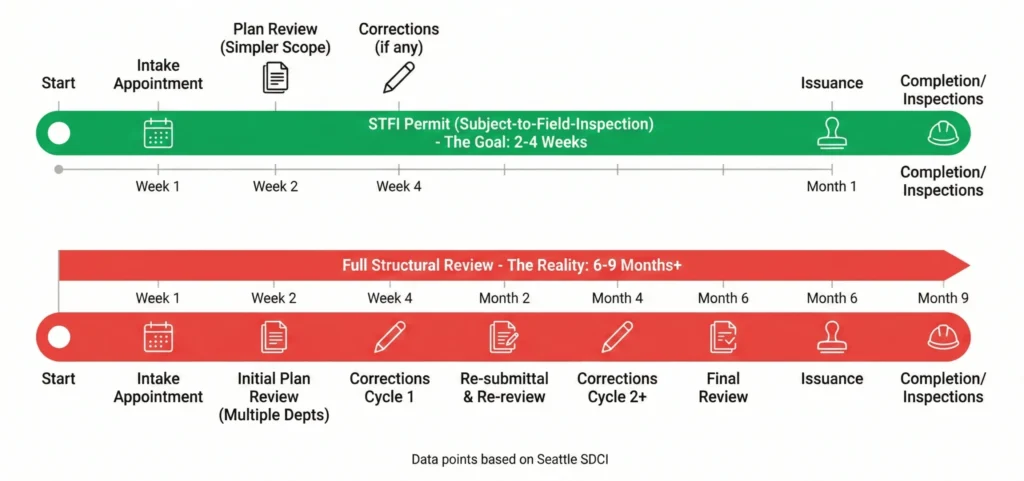
For many projects, the “Subject-to-Field-Inspection” (STFI) permit is the golden ticket. It is designed for projects that don’t alter the building envelope or require complex structural reviews.
- The Strategy: Experienced local contractors know how to design specifically to fit STFI criteria (Tip 316), potentially cutting wait times from months to weeks.
- The Risk: If you submit a complex plan that gets kicked into “Full Review,” you could face a 4-9 month wait just for initial processing
Seattle Construction Permit Speeds: STFI vs Full Review
The “Dumpster Tax”
In dense neighborhoods like Ballard or Capitol Hill, driveways are rare.
- The Cost: Placing a dumpster on the street triggers SDOT Street Use fees. Effective 2026, these fees accumulate daily based on square footage. A dumpster sitting for 3 months during a delay can rack up thousands in occupation fees.
4. Realistic Seattle Pricing Tiers (2026)
Forget the national averages. Below are realistic starting ranges for professional remodeling in the Seattle metro area for 2026. These figures include the local labor rates, high sales tax (approx. 10.35%), and typical material delivery challenges.
| Project Scope | Seattle Cost Estimate (2026) | The “Hidden” Factors Included |
| Cosmetic Refresh | $200 – $300 / sq. ft. | Finishes only. No wall moves. Assumes existing wiring is safe. |
| Mid-Range / Full Gut | $350 – $450 / sq. ft. | New layout, semi-custom cabinets, panel upgrade, potential drywall/plaster repairs. |
| Luxury / Custom | $450 – $650+ / sq. ft. | Structural beams, custom millwork, make-up air systems, high-end stone, seismic retrofitting. |
Note: “Wet” rooms (kitchens and baths) will always have a higher cost per square foot than bedrooms or living areas.
Conclusion: Planning is Your Best Defense
Remodeling in the Pacific Northwest requires a team that understands slopes, rain, and strict codes, not a franchise using a national playbook. A “cheap” estimate usually just means the contractor has left out the side sewer, the permit fees, or the electrical upgrades.
At Elite Remodeling Seattle, we build the “hidden” costs into our planning phase so they don’t become emergencies during construction. We navigate the SDCI backlog and the side sewer maps daily, ensuring your budget is spent on tangible value, not avoidable bureaucracy.
Are you planning a remodel in a pre-1960 Seattle home? Contact us today for a consultation that puts transparency and local expertise first.
If you would like to see some of our completed projects, head here for details and for our services check this page.
Official Seattle Remodeling Resources (2026)
Want to verify the codes or fees mentioned above? Here are the direct links to the official city and state documents used in this guide:
-
SDCI Tip 316 (Subject-to-Field-Inspection): Check if your project qualifies for the “Fast Lane” STFI permit.
View Tip 316 on Seattle.gov -
Seattle Side Sewer Maps & Responsibilities: Learn about homeowner liability for pipes in the public right-of-way (SMC 21.16).
Seattle.gov Side Sewer Guide -
SDOT Street Use (Dumpster) Permits: Current fee schedules for occupying the street or sidewalk during construction.
SDOT Street Use Permits -
2026 SDCI Fee Changes: Details on the recent fee restructuring for construction permits.
Building Connections: 2026 Fee Changes -
WA Labor & Industries (Electrical): Information on electrical permits and the 2023 NEC adoption.
WA L&I Electrical Basics
